How to Back Up Your Windows Installation With Macrium Reflect
Modern versions of Windows are much more resilient to problems than their ancestors. They also come equipped with tools that can attempt to fix any issue that pops up. In a worst-case scenario, there’s always the option of reverting your OS to its initial state or reinstalling it from scratch.
And yet, those options can be far from optimal. They can be complicated, time-consuming, and demand a lot of input from you.

That’s why keeping full backups of your OS with a tool like Macrium Reflect is much better, as we’ll see here. With such backups available, when catastrophe strikes, you’ll be able to restore your computer to its most recent working state in mere minutes. Let’s see how.
How to Download and Install Macrium Reflect
The first step for backing up your system with Macrium Reflect is downloading and installing the app. So, visitMacrium Reflect Free’s wensite, and scroll down a bit to find the download links.
Macrium also offers trials of the “Workstation” variant of the app. Skip those and download the “Macrium X Free” version (where X is the number of the version, which at the time of writing is “8”). Then, install it.

How to Create Macrium Reflect Rescue Media
Backups are useless if you cannot restore them. To do that, you need access to the app that created them. Since we’re talking about operating system (OS) backups, you’ll need access to them from “outside” the OS. That way, if something catastrophic happens to your PC, you can still get to its backup.
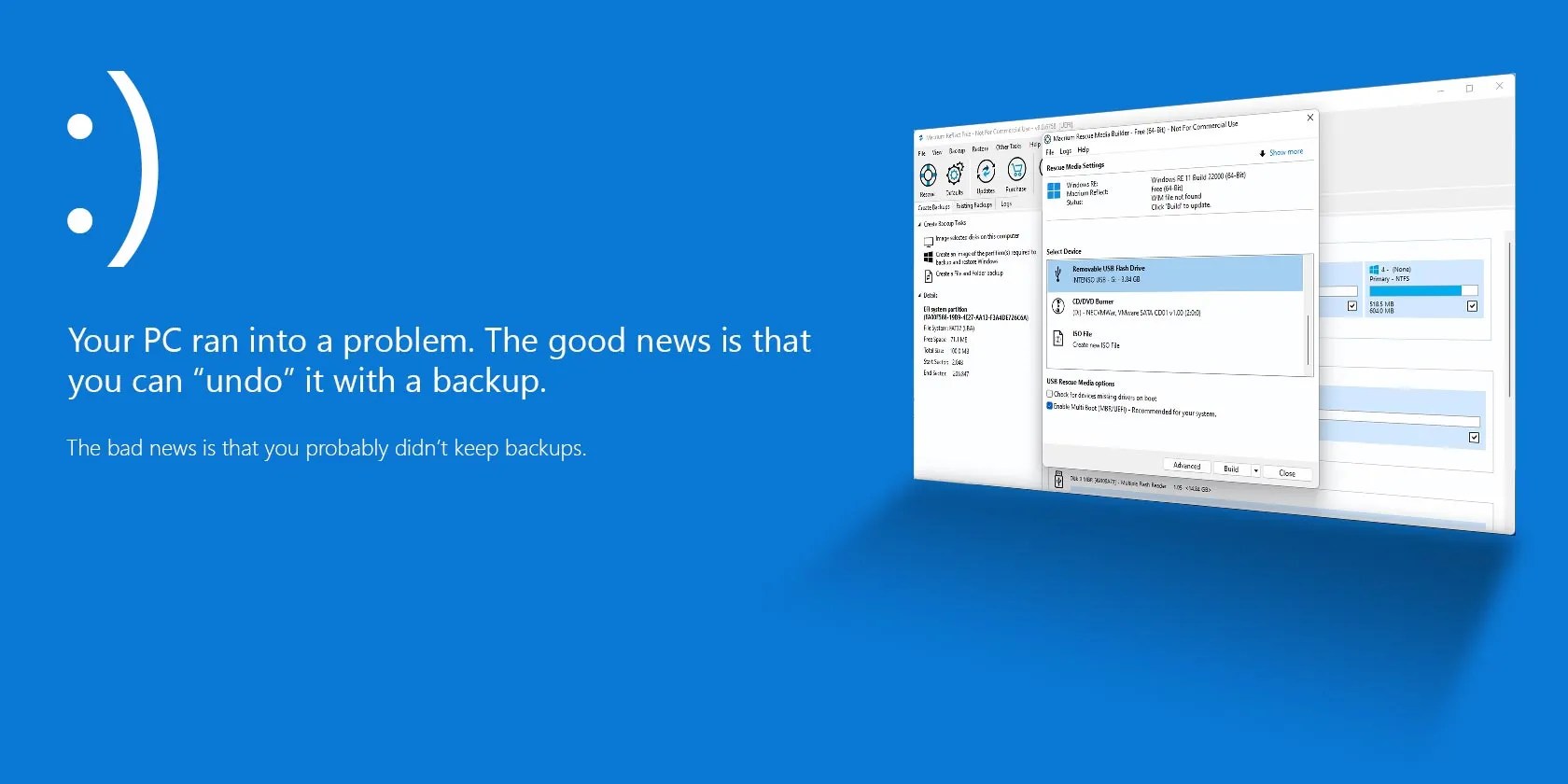
For that, you’ll have to create “rescue media”. Such media, usually in the form of an optical disc or a USB Flash Drive, allow you to boot your computer from them to access the software within.

Once done, you’ll be able to boot from your rescue media in the future, even if you’re able to’t reach your OS’s desktop. You can then run Macrium Reflect without issue and use it to restore the most recent backup of your OS.
To create a Macrium Reflect rescue media, run the app. Then, perform the following steps:

After that, wait a while, and soon your rescue media will be ready. Now all you need to do is put it away somewhere safe but easy to get to in case your PC encounters a critical error.
How to Back Up Your System With Macrium Reflect
With your rescue media ready, you can proceed to the actual OS backup. Macrium Reflect makes the process easy by offering an option for the purpose.
If you’re trying to back up your OS to a new external hard drive, you might meet some extra roadblocks. For example, your PC might refuse to recognize your spanking new storage device. Thankfully, we already have an article on the topic, so, feel free to check it out to findwhat you should do when Windows is not detecting your external drive during backup.
How to Update Your Backup in the Future
When you perform a backup, you’re taking a “snapshot” of your PC as it was when you made it. As such, you may like to update your backup in the future to better reflect what your PC looks like since you made the initial one.
Macrium Reflect can automatically update your backup based on the plan you chose when setting it up. However, sometimes you might want to update it manually—for example, before installing a questionable piece of software.
The rest of the process is self-explanatory. When it completes, your backup will be updated to reflect your OS’s current state.
Restore Your OS From a Backup
To restore your OS to a previous state using Macrium Reflect’s rescue media, boot your PC from it.
The way to do this also depends on your particular motherboard, so you should check its manual for more information. You’ll usually be able to press a key like F11 when your computer powers on to choose from which device to boot. Alternatively, you may have to change your storage devices' boot sequence through your motherboard’s BIOS/UEFI menu.
Once you’re booted into Macrium Reflect, it’s time to restore your backup.
If you like what Macrium Reflect “does”, but you find its interface complicated, check out our article onhow to perform effortless Windows backups with Veeam Agent. With that solution you’ll be trading some of the extra control Macrium Reflect offers for a more straightforward and streamlined backup process.
Backed Up Peace of Mind
By keeping a complete OS backup available, you’ll be able to revert any changes and undo catastrophic problems almost in no time. Whenever you wish, boot from Macrium Reflect’s rescue media, and choose your backup. Then, let your PC revert your OS to a previous state while you make a cup of coffee or catch up on your social media.
After the initial setup we saw here, you won’t have to overthink it again and only turn to your backup files when needed.
We’ve summarized every backup, restore, recovery, and repair option we could find on Windows 10. Use our simple tips and never despair over lost data again!
Free AI tools are legitimately powerful; you just need to know how to stack them.
The key is not to spook your friends with over-the-top shenanigans.
Your phone is a better editor than you give it credit for.
Not all true crime is about hacking, slashing, and gore.
You don’t need to fork out for expensive hardware to run an AI on your PC.
